
Pedal Assist E-Bike Repair: A Complete Guide to Keeping Your Ride Smooth
Pedal-assist e-bikes have become one of the most popular ways to commute, exercise, and explore — combining the simplicity of a regular bicycle with an electric motor that kicks in the moment you start pedaling. But like any machine that blends mechanical and electrical systems, pedal-assist bikes come with their own set of quirks and failure points. Understanding how the system works — and what tends to go wrong — can save you time, money, and a lot of frustration.
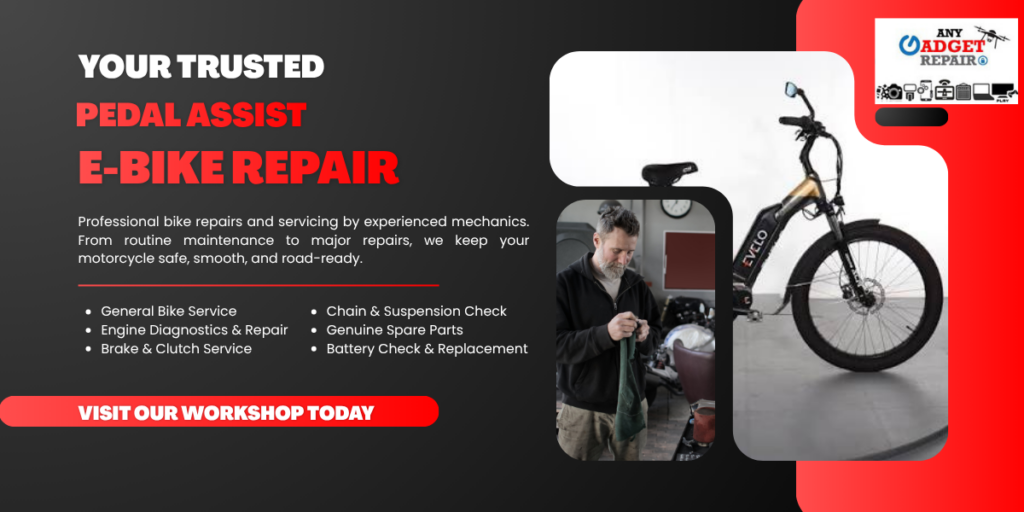
How Pedal Assist Actually Works
Unlike throttle-based e-bikes, a pedal-assist system (often abbreviated PAS) only delivers power when you’re actively pedaling. A sensor — either a cadence sensor (which detects that the pedals are turning) or a torque sensor (which measures how hard you’re pushing) — sends a signal to the controller, which then tells the motor how much assistance to provide. Most bikes let you choose an assist level, from a light boost to a strong push up hills.
This means a pedal-assist e-bike relies on several interconnected components working in harmony:
- Battery – stores and supplies power
- Motor – hub-mounted or mid-drive, converts electrical energy into pedaling assistance
- Controller – the “brain” that manages power delivery
- Sensors – cadence or torque sensors that detect pedaling input
- Display/console – shows assist level, speed, and battery status
- Standard bike mechanics – brakes, gears, wheels, and drivetrain
Because these systems overlap, a single fault can show up as a confusing mix of symptoms — for example, a battery that seems dead might actually be a wiring connector that’s come loose.
Common Pedal Assist Problems
1. No Power or Assist Not Engaging
If pedaling produces no motor response at all, the usual suspects are a discharged or faulty battery, a loose connector between the battery and controller, or a cadence/torque sensor that’s stopped reading properly. Sometimes it’s as simple as a safety cutoff switch (often built into the brake levers) that’s stuck or misaligned.
2. Inconsistent or Jerky Assistance
Power that cuts in and out, or surges unexpectedly, often points to a cadence sensor with a damaged magnet ring, a loose sensor bracket, or corroded wiring connections. Vibration from regular riding can gradually work these connections loose over time.
3. Reduced Range or Battery Not Holding Charge
Batteries degrade naturally, but a sharp drop in range can also be caused by a faulty charger, damaged battery cells, or a battery management system (BMS) fault. Extreme temperatures and storing a battery fully depleted for long periods will accelerate wear.
4. Motor Noise or Reduced Power Output
Grinding, clicking, or whining from the motor can indicate worn internal gears (common in geared hub motors), bearing wear, or debris that’s worked its way into the housing. On mid-drive motors, chain and drivetrain wear can also masquerade as a motor problem.
5. Display Errors or Blank Screen
An error code or blank display usually traces back to a wiring fault between the display and controller, a firmware glitch, or a failing controller itself. Many manufacturers use specific error codes, so noting the exact code before seeking help speeds up diagnosis considerably.
6. Standard Mechanical Wear
Don’t overlook the basics — e-bikes still have brakes, gears, tyres, and a drivetrain that wear out just like a normal bicycle. In fact, because e-bikes are heavier and often ridden at higher average speeds, brake pads, chains, and tyres tend to wear faster than on a standard pedal bike.
DIY Checks You Can Safely Do
Before booking a repair, a few basic checks can rule out simple issues:
- Confirm the battery is fully charged and the charger indicator light behaves normally
- Check that all connectors between battery, controller, and display are firmly seated
- Inspect the cadence sensor magnet ring for visible damage or misalignment
- Look for pinched, frayed, or chafed cables, especially near pivot points
- Make sure the brake lever cutoff switches aren’t sticking
When to Call in a Professional
Anything involving the battery, motor internals, or controller is best left to a qualified technician. E-bike batteries carry a real risk of fire or injury if mishandled, and motor or controller faults often require diagnostic tools and manufacturer-specific knowledge to pinpoint accurately. A shop that regularly works on electric bikes — not just standard pedal cycles — will typically have the experience to distinguish between an electrical fault and a mechanical one quickly, saving you the cost of guesswork.
If you’re in Birmingham and dealing with a pedal-assist bike that’s lost power, won’t charge, or is throwing up display errors, Any Gadget Repair offers dedicated electric bike repair services covering battery issues, motor faults, controller and wiring problems, and general pedal-assist maintenance, alongside the full range of standard bike repairs like brakes, gears, and wheels.
Keeping Your Pedal Assist System Healthy
A little routine care goes a long way:
- Store the battery at room temperature and avoid leaving it fully depleted for extended periods
- Keep the drivetrain clean and lubricated — a dirty chain puts extra strain on the motor
- Check tyre pressure regularly, since underinflated tyres make the motor work harder
- Have connectors and cabling inspected periodically, especially if you ride in wet or muddy conditions
- Avoid jet-washing sensitive electrical components directly
Treat the electrical side of your e-bike with the same care you’d give the mechanical side, and it’ll reward you with years of smooth, reliable assistance.
Having trouble with your pedal-assist e-bike? Get in touch with the team for a diagnosis and repair quote.
Related Posts
-
 Mastering the Trails: Comprehensive Mountain Bike Repair by Any Gadget Repair
-
 Electric Bike Repair Services in Birmingham & Nationwide
-
 Professional E-Scooter Repair Services in Birmingham — Fast, Reliable & Affordable
-
 Professional Mountain Bike Repair Services in Birmingham – Expert Care for Every Trail and Terrain
About The Author
